Select Category


AI Summary
5 key insights · 1 expert tipIn 2026, wardrobe material costs in India range from Rs. 850 to Rs. 3200 per square foot, depending on the structural framework material, shutter finish and the hardware you choose. These three components together account for roughly 50 to 60% of the total wardrobe cost and nearly all of the wardrobe's long-term performance. Let’s look at the wardrobe material cost breakdown in detail for more clarity.
KEY INSIGHTS
- Various factors that affect wardrobe material costs.
- Material-wise cost comparison by wardrobe type and bedroom type.
- Budget-friendly and premium wardrobe materials for modern homes.
- Some hidden costs to consider when budgeting for a wardrobe.
- How to choose the right wardrobe material for your budget?
 DESIGNCAFE EXPERT TIP
By our design team
DESIGNCAFE EXPERT TIP
By our design team
Aditi Shetkar, Design Manager, DesignCafe Experience Centre, Pune, says, “Do not let the shutter finish decide your entire budget. Make the structural framework and wardrobe hardware a priority, followed by the shutter finish to achieve the perfect balance of durability and performance.”
Here’s what plywood, MDF, HDHMR, acrylic and every other wardrobe material option actually costs in 2026 and where each one makes sense.
Every wardrobe design quote looks rational until you ask about what is actually inside it. The structural framework board, shutter finish and hardware you pick will do more to your final bill and to how the wardrobe survives Indian summers and monsoons than any wardrobe design flourish. This quick cost guide breaks down what each wardrobe material costs in 2026, where it holds up and where it doesn’t, to help you make an informed choice.
Factors That Affect Wardrobe Material Costs
- Wardrobe shutter material – Laminate, PU, acrylic, veneer, or glass. Come with their own prices.
- Wardrobe hardware – Hinged doors cost less than sliding doors with soft-close mechanisms.
- Wardrobe accessories – Drawers, pull-out racks, jewellery trays and lighting add up quite fast.
- City and labour rates – Different cities have varying labour rates, which increase overall costs.
- Structural framework – Particle board, plywood, MDF and HDHMR carry different costs and moisture tolerance.
- Wardrobe size & design complexity – Lofts, curves, and custom cuts increase both material wastage and labour hours.
Wardrobe Material Comparison
| Wardrobe By Material | Costs Per Sq.Ft. (Rs.) | Details |
| Plywood Wardrobe Cost | Rs. 1300 to Rs. 1800 (BWP/marine plywood and laminate combo) | Commercial Plywood (best for low-moisture bedrooms and for internal, non-visible sections of the wardrobe).MR Grade Plywood (best for standard bedroom wardrobes because it tolerates occasional dampness). BWR and BWP Plywood (best for wardrobes in coastal cities or bedrooms with an attached bathroom, since it resists warping and delamination far longer than MR-grade plywood). |
| MDF Wardrobe Cost | Rs. 850 to Rs. 1200 (MDF and laminate combo) | It is the go-to substrate option when you want a perfectly smooth shutter surface for laminate, acrylic or paint finishes. The trade-off is moisture resistance. |
| HDHMR Wardrobe Cost | Rs. 1100 to Rs. 1500 (HDHMR and laminate combo) | Suited for wardrobes in bedrooms without an attached bathroom, where the building itself is in a humid zone. It resists swelling more effectively, without the full price jump. |
| Particle Board Wardrobe Cost | Rs. 1400 to Rs. 2200 | Made from compressed wood particles and resin, which keeps costs low but also keeps strength and moisture resistance low. It suits wardrobes which are not expected to carry heavy loads or last more than 6-8 years. |
| Solid Wood Wardrobe Cost | Rs. 2200 to Rs. 3200 | It is the ideal choice for clients who want an heirloom piece rather than a factory-finished modular unit. The cost reflects both the raw timber and the additional carpentry hours that solid wood demands. |
| Glass Shutter Wardrobe Cost | Rs. 2000 to Rs. 2800 (glass and laminate combo) | The cost of a wardrobe with glass shutters climbs with thickness, tinting or frosting of the glass. Glass is inset as a feature panel on sliding doors or used in walk-in wardrobe display sections. |
| Aluminium Shutter Wardrobe Cost | Rs. 1800 to Rs. 2600 | It is chosen less for cost efficiency and more for the slim, handle-less sliding profiles it enables. It offers a look that is hard to replicate with wood-based frames. |
| Acrylic Finish Wardrobe Cost | Rs. 1600 to Rs. 2200 | The appeal is the mirror-like, glass-style gloss it gives shutters. The only catch is maintenance, because acrylic shows fingerprints and dust far more visibly than laminate and requires daily wiping to maintain that showroom finish. |
| Laminate Finish Wardrobe Cost | Rs. 1400 to Rs. 2200 | It resists daily scratches and knocks better than acrylic, comes in a variety of textures and colours and doesn’t demand the upkeep that a high-gloss finish does. |
| Veneer Wardrobe Cost | Rs. 2000 to Rs. 3000 | It gives you the visual warmth of solid wood at a fraction of the cost, but it does need more careful handling than laminate because scratches show. |
| PU Finish Wardrobe Cost | Rs. 2200 to Rs. 3200 | The PU finish is sprayed and cured rather than laminated, which is why it gives such a seamless matte or satin look and costs more than laminate or membrane. It also holds up better against moisture than most finishes. |
Wardrobe Material Costs By Wardrobe Type
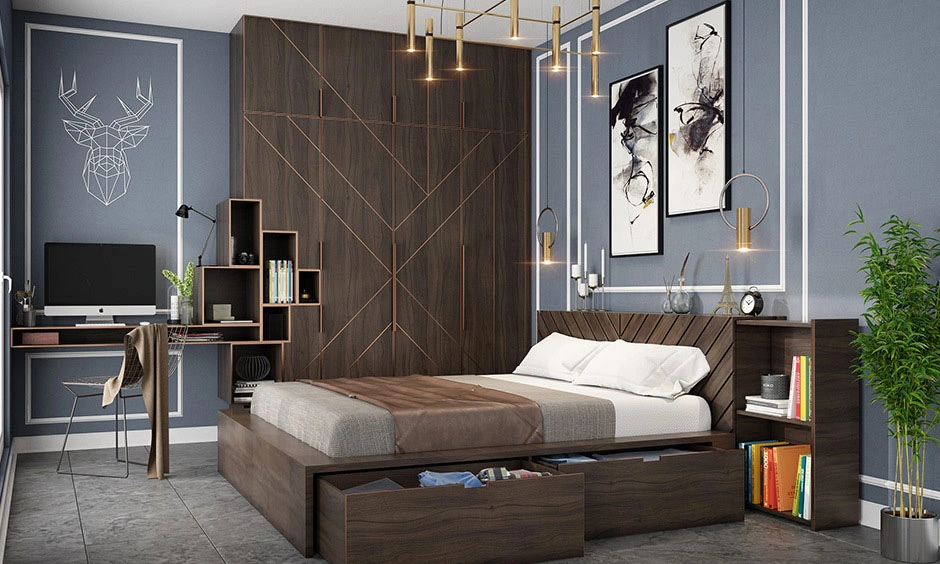
1. Sliding Door Wardrobes
Sliding-door wardrobes cost more per square foot than hinged-door wardrobes because of the track hardware. They are a practical choice for compact Indian bedrooms, since the hinged door requires 2.5 feet of clearance to swing open, which not all bedrooms can provide.
2. Hinged Door Wardrobes
They are more affordable than sliding-door wardrobes and are common in larger bedrooms or where the wardrobe design runs along a wall, leaving open floor space in front. The material costs are identical to sliding wardrobes, and the savings come entirely from simpler hardware.
3. Walk-In Wardrobes
A walk-in wardrobe built into a dedicated 6 ft by 8 ft space costs Rs. 1 lakh to Rs. 3 lakhs, depending upon the internal material mix – plywood shelving, glass display sections, drawer units and lighting.
Wardrobe Interior Design Ideas For Modern Homes



Best Wardrobe Material For Different Bedroom Types
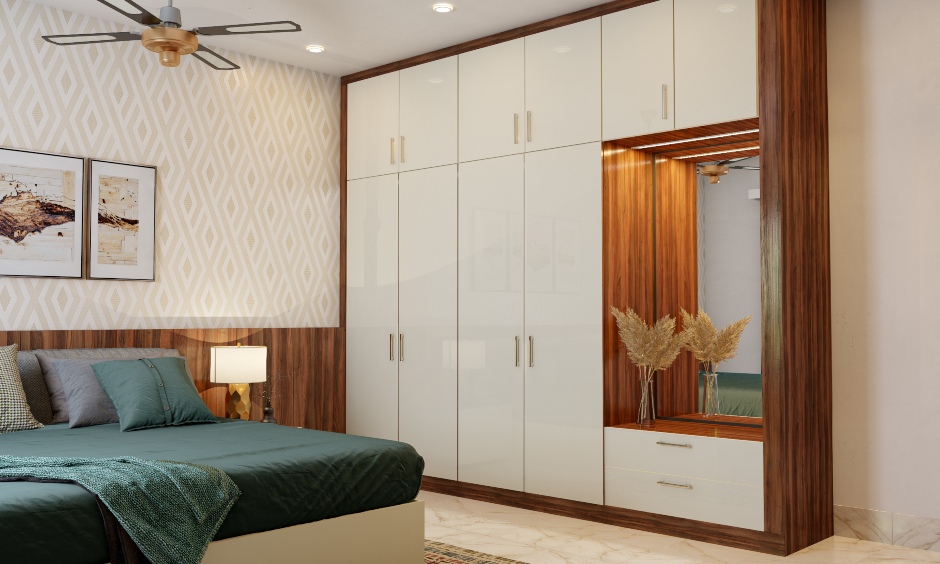
1. Master Bedroom Wardrobes
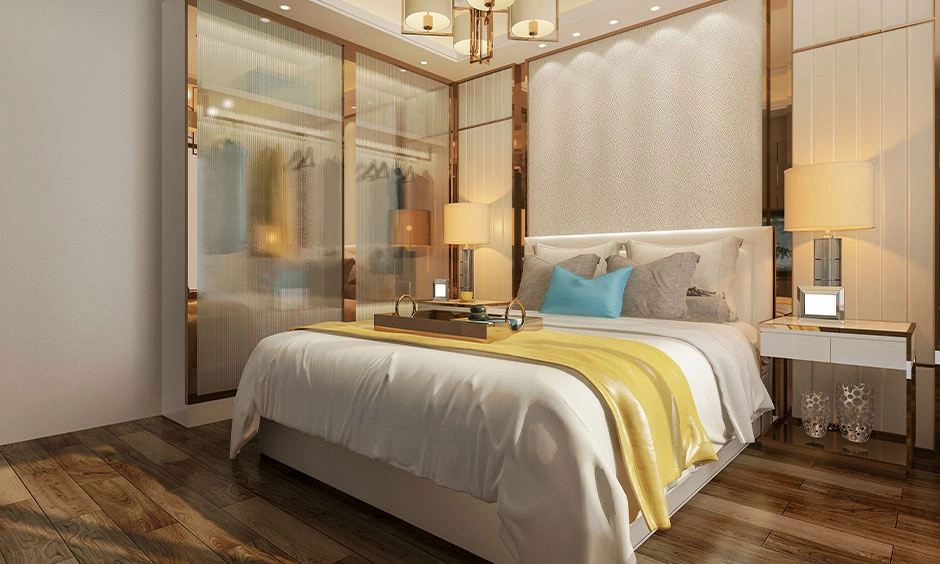
Master bedroom wardrobes carry the highest material specifications in the house – BWR or HDHMR framework, laminate or PU shutters and soft-close hardware – since this is the wardrobe which is used daily by the primary occupants.
2. Kids’ Bedroom Wardrobes
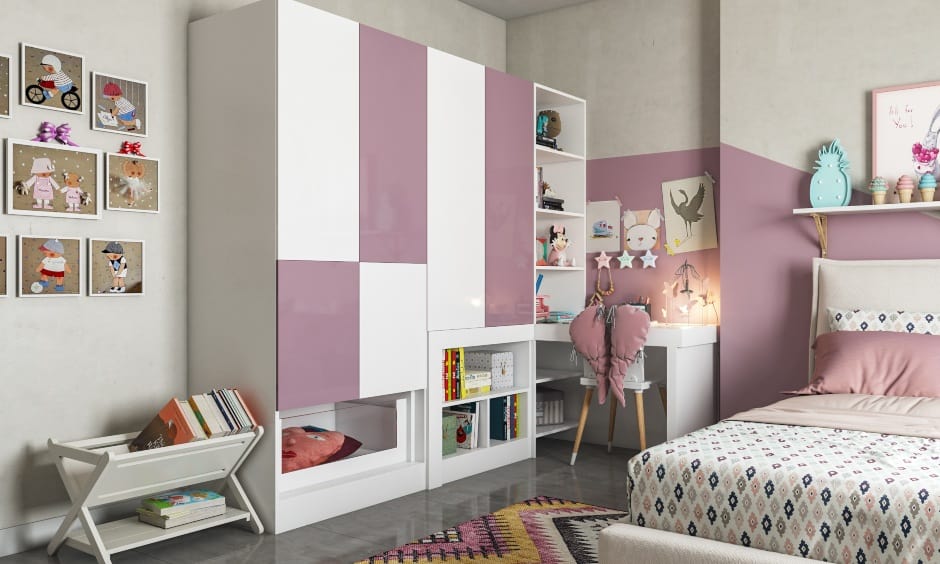
The kids’ bedrooms typically feature laminate wardrobes, since laminate hides scuffs and crayon marks better and requires less care. Budget-grade MDF or particleboard frames are more defensible, since the wardrobes can be resized as the child grows.
3. Guest Bedroom Wardrobes
The guest bedrooms see the least daily use, which makes them a sensible place to economise. An MR plywood or particleboard framework with a laminate finish delivers a presentable wardrobe without spending master-bedroom money on a space used only a few weeks a year.
A Quick Overview Of Modern Wardrobe Materials (Budget VS Premium)
| Budget-Friendly Materials | Premium Luxury Materials |
| Particle board or MR plywood Laminate shuttersHinged doors with basic hingesBasic hinges and no integrated lightingFewer drawers and no racks | BWP or BWR plywoodAcrylic or PU shuttersSliding doors with full soft-close mechanismsIntegrated LED lighting and smart locksJewellery drawers, trouser/shoe racks |
Hidden Costs To Consider When Budgeting For A Wardrobe Apart From Materials
- Loft additions (added on top of the base wardrobe).
- Labour/carpentry charges (factory-made versus site-built wardrobe).
- GST-confirm (whether quoted rates are inclusive or exclusive of GST).
- ABS edge banding (it costs more per running foot but lasts the wardrobe’s life).
- Internal lining for interior surfaces (adds a separate cost beyond the external shutter finish).
- Delivery and installation costs (which are quoted separately and easy to miss when comparing quotes).
Latest Wardrobe Material Trends For 2026
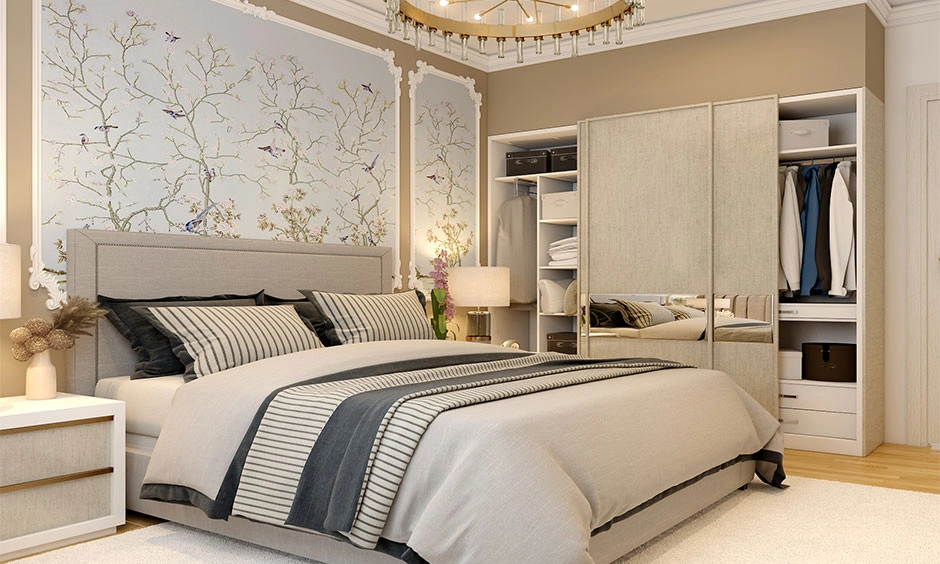
- Matte laminates and textured laminates in grey and beige tones are replacing high-gloss finishes.
- Fluted glass panels are used as inserts on sliding wardrobe doors for a translucent/modern look.
- Handleless profiles (J-profile/push-to-open mechanism) in aluminium or MDF have become popular.
- Floor-to-ceiling designs with integrated lofts extend material footprint to 8-9 feet for a built-in look.
- Motion-sensor LED lighting is built into wardrobe interiors and paired with HDHMR to cleanly house the wiring.

How To Choose The Right Wardrobe Material For Your Budget?
1. Set your total wardrobe material budget and then decide how it splits.
The structural framework and hardware specifications should take priority over shutter finish because they determine how long the wardrobe lasts. A well-apportioned budget balances itself across the home with considerations for high-traffic vs low-traffic areas.
2. Check the moisture exposure in the room and then decide the material.
For an upper-floor bedroom, MR plywood or MDF is the best wardrobe material, whereas BWP plywood or HDHMR is suitable for an attached bathroom.
3. Match the finish to how the wardrobe will be used.
High-traffic areas and kids’ rooms need laminate wardrobes, while rarely-touched or formal spaces are better served by acrylic or veneer wardrobes.
4. Do not skip the hardware specifications.
An upgrade from Rs. 5000 to Rs. 15000 for branded soft-close hinges and runners is often the single best-value line item.
Wrapping Up
The wardrobe material prices in 2026 span a wide range for good reason, as a master bedroom in a humid city needs BWP plywood to last, while a particle board and laminate build serves a guest room just fine. The material choice you make today is the maintenance bill or the replacement bill you are likely to avoid five years from now, so it is essential to get the wardrobe material right, even if it means trimming the shutter finish. If you are confused about the best material for your wardrobe designs, the interior experts at DesignCafe are here to give you a detailed, material-by-material breakdown and comparison to make your decision easier. Book A Free Appointment Now!
FAQs
1. How much does wardrobe material cost per sq.ft.?
Wardrobe material costs in the range of Rs. 850 to Rs. 3200 per square foot in 2026, depending upon the structural framework, shutter finish and the hardware quality chosen.
2. What are the most durable wardrobe materials in 2026?
- Solid wood – It outlasts every engineered board, but it is quite expensive.
- Aluminium-framed shutters – These don’t warp, rot or absorb moisture at all.
- PU-finished shutters – They offer better colour/moisture resistance than laminates.
- HDHMR with laminate shutters – They are affordable and have near-plywood durability.
- BWP marine-grade plywood is the benchmark for humid Indian conditions.
3. Are sustainable wardrobe materials available?
Eco-friendly wardrobe materials are available that help reduce environmental impact while delivering better performance, such as bamboo panels and low-VOC boards and finish