Select Category


AI Summary
5 key insights · 1 expert tipA kids’ wardrobe with a study table combines clothing storage and a study area into one unit, making it the most practical solution for small bedrooms. With specifications outlined correctly for the child's age, room dimensions and future growth, an integrated unit delivers measurably better organisation, study habits and spatial efficiency than separate furniture ever can.
KEY INSIGHTS
- How can an integrated unit outperform separate furniture in small rooms?
- Six design typologies and six features to prioritise for the kids’ bedroom
- Smart storage strategies that are specific to the compact kids’ bedrooms
- How to select the right type of storage and study unit for the children’s room
- Common mistakes to avoid when designing a kids’ wardrobe with a study table
 DESIGNCAFE EXPERT TIP
By our design team
DESIGNCAFE EXPERT TIP
By our design team
Jessica Fernandes, Senior Studio Manager, DesignCafe, Bengaluru, says, “ You can recover vertical volume and eliminate the floor clearance that hinged doors demand in just one move with absolutely no reduction in storage using an integrated wardrobe and study table unit in a kids’ bedroom.”
Break down how to choose, configure and get lasting value from an integrated wardrobe and study setup in a compact kids’ bedroom.
Designing a small child’s bedroom well is way harder than it looks. The sharpest tension for the modern homeowner is between storage and study. Most parents resolve it by prioritising one over the other – a generous wardrobe that leaves no room for a proper desk or vice versa. A kids’ room wardrobe with a study table removes that trade-off by integrating both functions into a single purpose-built unit that resolves the spatial conflict and creates a room that feels deliberate rather than cobbled together.
This quick guide covers the design principles, typologies, selection criteria and practical considerations for the modern homeowner to square in on the right type of kids’ wardrobe with a study table unit, be it for a small or large bedroom.

Why Is It Important To Choose A Kids’ Wardrobe With A Study Table Design For Small Rooms?
It maximises the available floor space in a small bedroom.
A freestanding wardrobe and a separate study table each consume their own footprint plus the circulation space around them. A combined kids’ wardrobe with study table unit collapses both into a single wall-aligned piece, leaving the rest of the room genuinely clear for easy movement.
It keeps both the study and storage organised.
When storage and study are separate and unconnected, the kids’ belongings drift like textbooks migrating to wardrobe shelves or clothes ending up on the desk chair. An integrated unit creates defined zones for each category of item, and the proximity of the two functions reinforces the organisation.
It creates a dedicated learning zone.
A child who studies at the dining table is working in a borrowed space that is not associated with study and is not consistently available. A child who has a designated desk in their bedroom has a space for focused work, which is an advantage as academic demands increase. A permanent boundary anchors focus.
It reduces the bedroom clutter.
Clutter in a child’s room is a storage failure because things accumulate where they don’t belong. A properly configured integrated kids’ wardrobe design with a study unit provides a home for every item category the child uses daily. The tidying process requires less effort, and the room stays ordered for longer.
It encourages better study habits among kids.
An ergonomically correct desk at the right height with adequate task lighting and organised storage for study materials removes the low-level friction that makes sitting down to study feel harder. Children who have a well-equipped study space use it more consistently and productively.
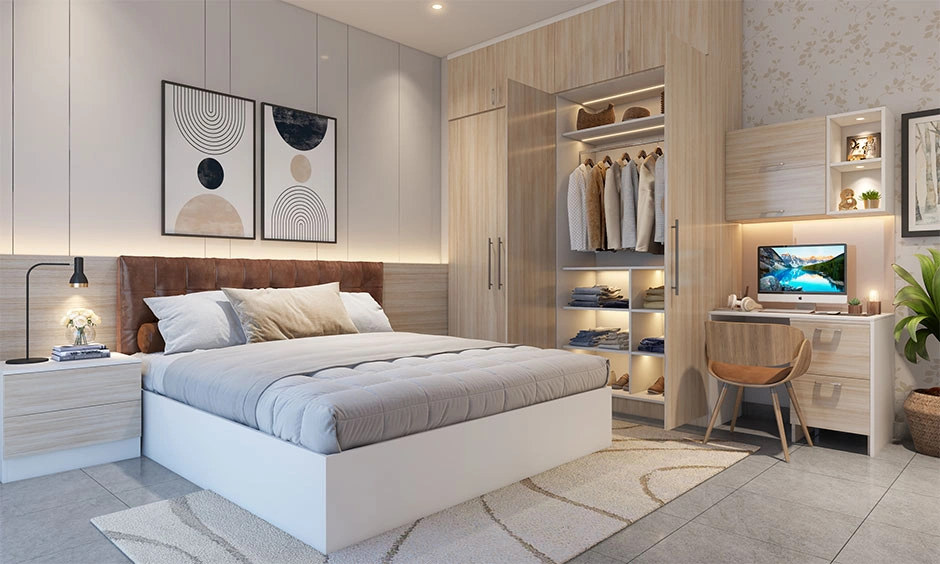
Premium Kids Bedroom Designs


What Are The Key Features To Look For In A Kids’ Wardrobe With A Study Table?
When evaluating design options for a kids’ wardrobe with a study table, these are the features that matter the most from both a functional and a safety standpoint:
Adequate Wardrobe Storage
The wardrobe components must be functional. For school-going children, this means a hanging section for uniforms and occasion wear, dedicated drawer space for daily-use clothing and shelf space for folded items, shoes, etc. As the children grow, their wardrobes expand considerably. Prioritise wardrobe units with flexible internal configurations that can be reconfigured as needs evolve.
Ergonomic Study Table Design
The study table design must be sized and positioned correctly for the children who will use it. For growing children, a height-adjustable desk surface is ideal, and the surface area itself should be sufficient to accommodate an open textbook, a notebook and a device simultaneously, which is increasingly the standard study setup for school-age children.
Built-In Shelves And Drawers
Shelves and drawers integrated into the unit serve the study area as much as the storage area. Shelves positioned above or beside the desk provide immediate access to reference books and frequently used materials without requiring the child to get up. Drawers within reach of the study surface keep stationery organised, off the desk and make it a more usable workspace.
Safe Rounded Edges For Children
Sharp corners and hard edges on children’s furniture pose a genuine safety risk, particularly in smaller rooms where children move quickly and are in close proximity to furniture. Well-designed kids’ furniture rounds all the exposed edges and corners, minimising the risk of injury from accidental contact. This is a non-negotiable feature for bedrooms used by younger children.
Durable And Easy-To-Clean Materials
Children’s furniture is subject to significant daily wear, so the materials should be selected for resilience, ease of cleaning, and appearance. High-quality laminates, moisture-resistant board substrates, and lacquered finishes all hold up better than untreated or poorly finished surfaces. For example, matte laminates are more forgiving of fingerprints or surface marks than glossy finishes.
Proper Lighting Integration
The kids’ study area requires adequate and well-directed light. Overhead room lighting is rarely sufficient for desk work because it casts shadows across the work surface when a child leans forward to write. Integrated task lighting is also a meaningful quality-of-life feature. Lastly, warm white and neutral white light in the 3000–4000K range is generally most comfortable for extended study sessions.
What Are Popular Kids’ Bedroom Wardrobe With Study Table Options?
- Modular Kids Wardrobe With Study Table – Modular systems are assembled from standardised components that can be arranged to suit a specific space and reconfigured as requirements change.
- Built-In Wardrobe With Study Table – A built-in unit is designed around the actual dimensions and constraints of the kids’ room. They require a high upfront investment but deliver an aesthetically coherent outcome.
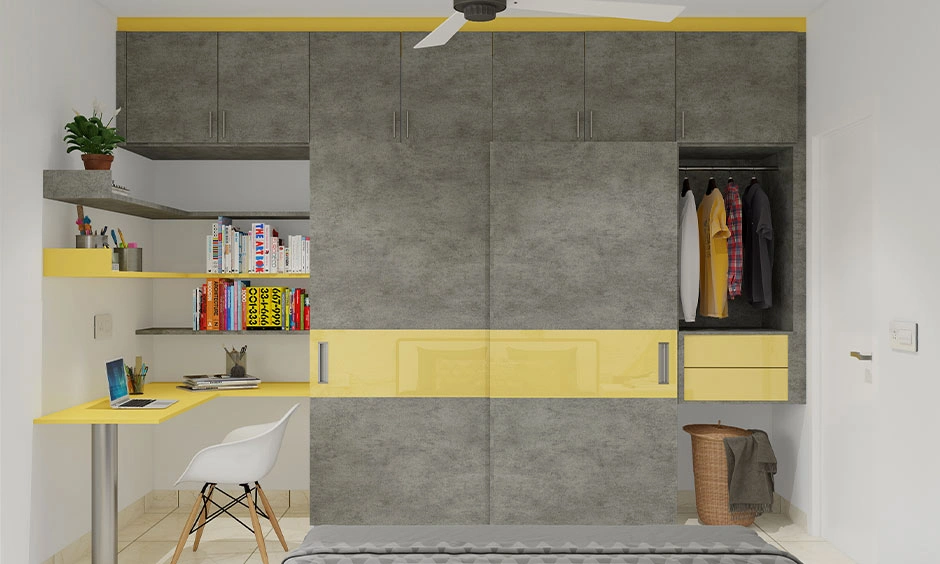
- L-Shaped Wardrobe With Study Table – The L-shaped configuration places wardrobe storage along one wall and extends the desk surface along the adjacent wall, both units merging at the corner.
- Wardrobe With Pull-Out Study Table – A pull-out study desk surface integrated into the wardrobe unit is the most spatially honest solution, as it is present when needed and absent when not.
- Wardrobe With Foldable Study Table – A fold-down desk uses a wall-mounted hinge mechanism. When folded down, it provides a work surface. When folded up, it blends with the wardrobe face and forms a single unit.
- Modern Study Table With Wardrobe Designs – The ambition of a modern study table with a wardrobe design is to be recognised as a single resolved object. The latest integrated designs are characterised by material or finish consistency throughout the unit, push-to-open mechanisms, and built-in cable management.
What Is The Cost Of A Kids’ Wardrobe With A Study Table For A Small Room?
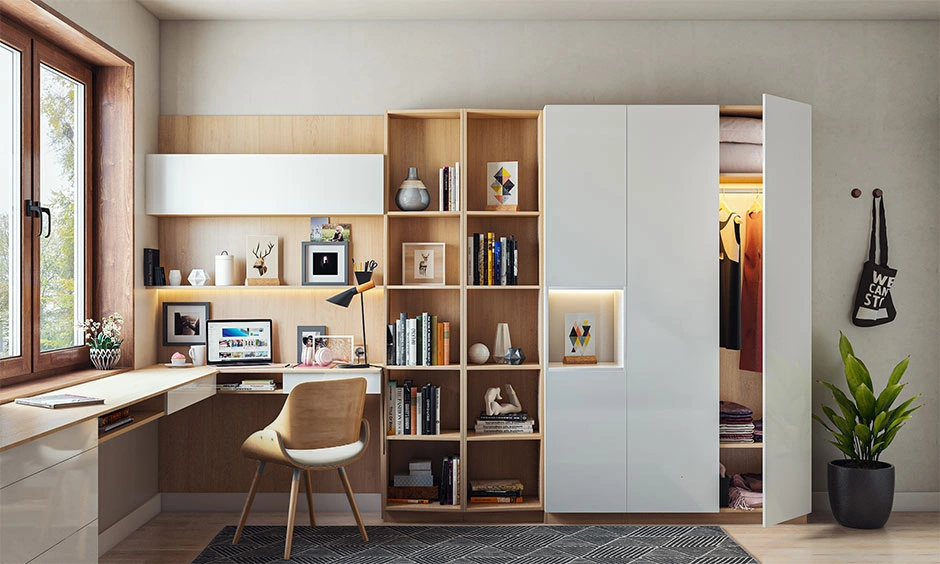
The cost of a kids’ wardrobe with a study table for a small room generally ranges between Rs. 3 lakhs to Rs. 3.5 lakhs. This estimate includes a standard 6-foot sliding wardrobe, a study table with storage, plywood carcass material and standard laminate finishes. Any customisation in laminate finishes, materials or design elements may increase the overall cost by approximately 15% to 20%. The final cost of the kids’ room will also depend upon additional requirements such as the bed design, loose furniture, wall treatments, wallpaper and false ceiling design.

How To Select The Right Bedroom Wardrobe With A Study Table?
- Measure the available space accurately so that the right kind of furniture can be selected, like the overall dimensions, the positions of windows, doors, power outlets and any structural projections. Note which walls receive natural light because this will inform the best position for the study surface.
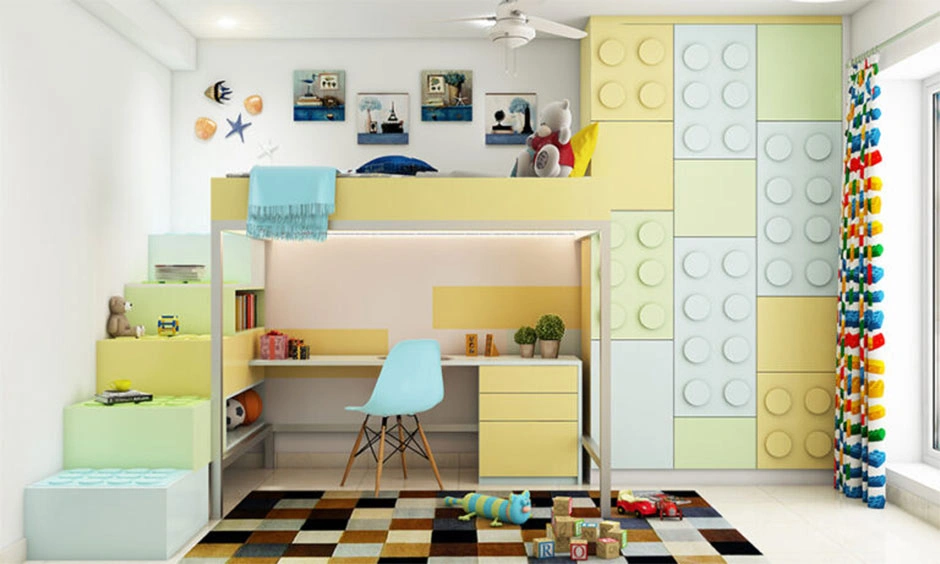
- Consider your child’s age because it determines the ergonomic requirements of the study surface, proportions of the wardrobe interiors and appropriate level of visual complexity in the design. A wardrobe and study table unit designed for a 7-year-old should have a lower desk height, accessible lower storage and a more playful aesthetic. However, a wardrobe and study table unit designed for a 12-year-old needs a standard desk height, sophisticated storage for files and digital devices and a design language that will remain relevant for a few years.
- Choose the right storage configuration and ensure the wardrobe’s internal configuration matches the storage needs of the child who will use it. This varies considerably by age, by the number of school uniforms and activity-specific clothing items required and by whether the wardrobe will also need to accommodate toys, books or sports equipment. A configuration audit is a useful exercise before finalising any specification.
- Focus on future growth requirements, as children grow quickly and their storage and study needs evolve at a corresponding pace. A wardrobe and study unit purchased for a primary school child will ideally still be serving well into secondary school, which means prioritising adjustability over fixed and highly specific arrangements that are optimised for one particular moment in a child’s development, like shelves that can be repositioned, desk heights that can be modified and configurations that can be updated.
- Match the wardrobe and study unit to the overall kids’ bedroom theme; this does not mean they need to be identical in finish to every other element (~some contrast can be desirable), but they should share the same aesthetic. For instance, a heavily themed and character-driven wardrobe and study unit will feel incongruous in a room designed around a sophisticated and mature palette.
What Are Common Mistakes To Avoid When Designing A Kids’ Wardrobe With A Study Table?
- Ignoring future storage needs is one of the most common mistakes in kids’ bedroom design. A unit that perfectly accommodates a 7-year-old’s wardrobe will be undersized within a few years as the child’s clothing inventory grows and the school materials and additional equipment multiply. Designing with a 5-7 year horizon in mind and prioritising reconfigurable systems is the more prudent approach.
- Choosing oversized furniture involves selecting a unit which is technically capable of providing generous storage but is disproportionately large for the room it occupies. An oversized unit makes a small room feel smaller and compromises circulation and safety. A well-proportioned wardrobe and study unit that fits the room well and provides adequate storage is always preferable to one that dominates the space.
- Poor lighting around the study area, like relying on a ceiling light positioned at the centre of the room to illuminate a desk along one wall, typically results in a study surface that is in partial shadow, which is exactly the wrong condition for a child spending an hour or more doing detailed work. Dedicated task lighting for the desk, at the correct height and with an appropriate colour temperature, is a functional requirement.
- A lack of safety features compromises the kids’ welfare, be it work or leisure. Soft-close drawer and door mechanisms prevent the sudden slamming that can cause finger injuries. Anti-tip wall fixings prevent tall units from toppling when a child uses them as a climbing aid. Rounded external corners on all accessible edges reduce the consequences of accidental contact.
- Overlooking ventilation in a kids’ room creates daily friction that erodes the usability of the space, like a wardrobe positioned against the only natural ventilation or a study unit placed in a way that makes the desk difficult to approach and exit. Adequate air circulation affects both the preservation of clothing within the wardrobe and the general air quality of the sleeping and study environment.
What Are The Design Ideas for a Kids’ Room Wardrobe with a Study Table?
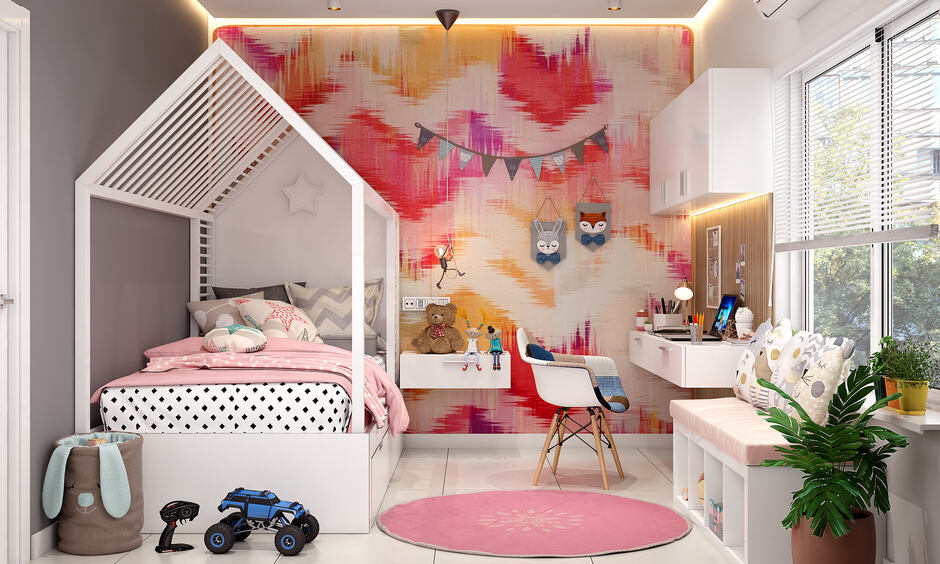
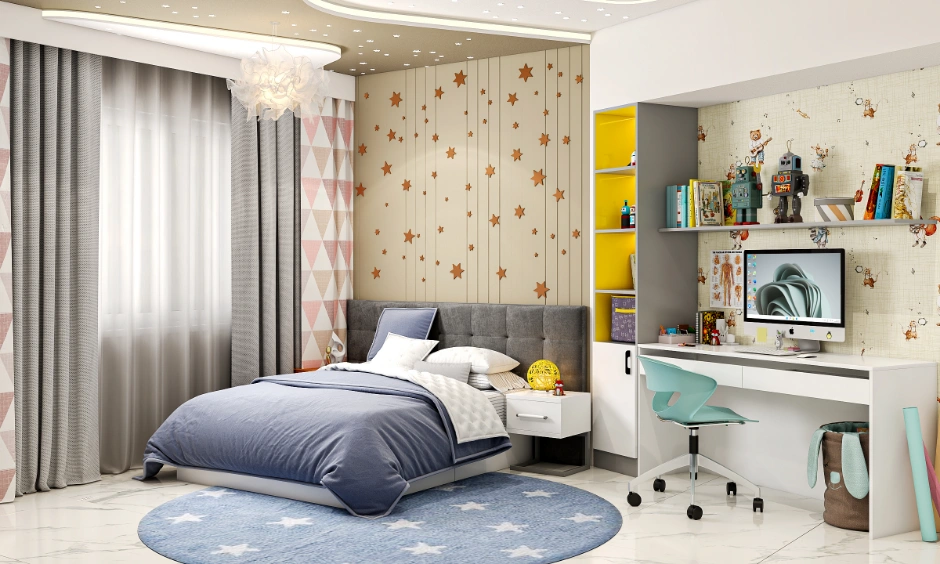
- For children in the primary school years, colour plays an important role in making a space feel welcoming and stimulating. Wardrobe units in soft primary or pastel tones with contrasting accents on handles or shelving edges create a cheerful environment without being visually overwhelming.
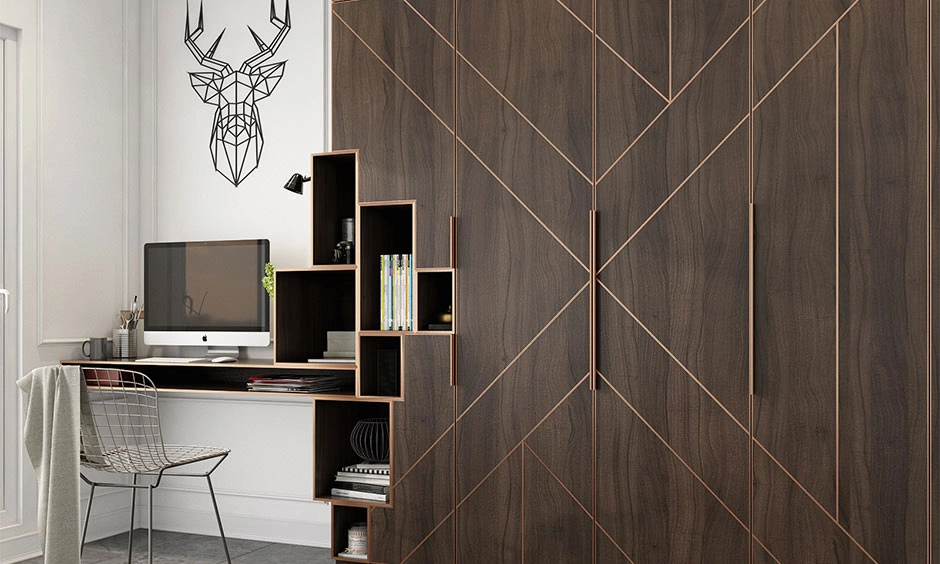
- Clean lines, neutral tones and minimal visible hardware create a study and storage environment that feels appropriately sophisticated. A minimalist unit also provides a neutral backdrop against which teenagers can express their own personality through art, photography and personal objects.
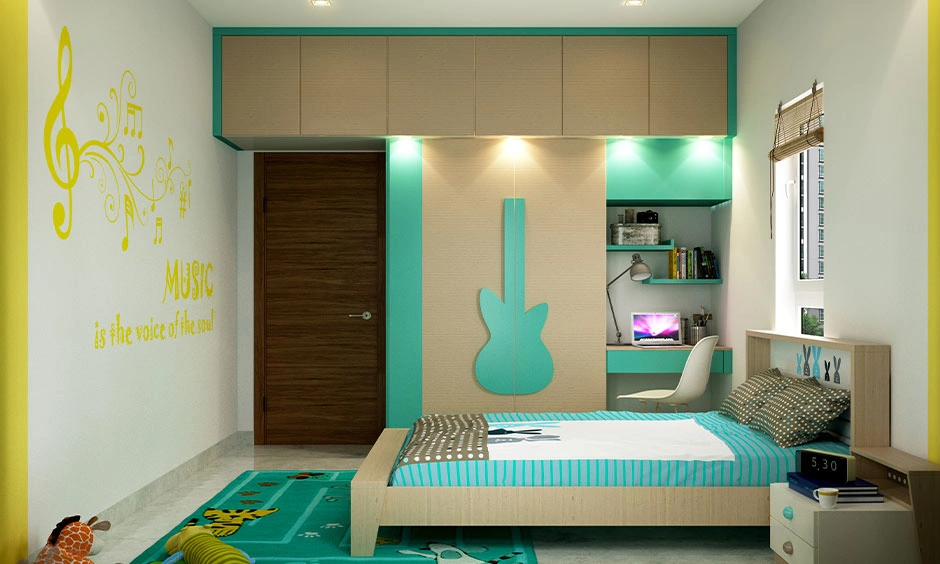
- For younger children with strong interests, a themed study and storage unit can make the bedroom a genuinely exciting and personal space. From a design perspective, the caveat is longevity: themes that are more abstract and less character-specific tend to age more gracefully.
- Kids’ room interiors that are not designed around conventional gender associations offer greater flexibility over time like for resale or for a child with evolving tastes. Earthy neutrals and natural wood finishes are the best palettes as they feel calm and contemporary and work equally well for all genders.
- Integrated kids’ furniture leans towards an ultra-clean aesthetic expression combined with high functional density. Push-to-open panels, integrated cable management for devices and foldable surfaces that close flush with the wardrobe face contribute to a unit that looks deceptively simple while doing highly functional work.
Wrapping Up
A well-designed kids’ wardrobe with a study table does several things together that matter in a small bedroom. It resolves the spatial competition between storage and study, creates a dedicated learning environment within the child’s own room and reduces the visual and physical clutter that accumulates when furniture is insufficient or poorly organised. Selecting the right kids’ wardrobe with a study table design requires thinking through a refined set of questions at the design stage, whose answers should drive the specifications. Are you planning a kids’ wardrobe with a study table design for your home and wanting to take the first step? Reach out to the DesignCafe team for an estimate and your queries.
FAQs
1. Why are modular kids’ wardrobes with study tables trending?
Modular kids’ wardrobes with study tables are trending because they offer flexible layout configurations, customisable storage solutions, better space utilisation and long-term cost efficiency.
2. What are the best kids’ wardrobe designs for small rooms?
- Vertical storage design solutions
- Compact corner wardrobe designs
- Wall-mounted study table concepts
- Space-saving sliding door wardrobes
- Multi-functional furniture designs
3. What are some of the storage tips for maintaining a kids’ bedroom wardrobe with a study table?
- Use organisers to divide the drawer space into specific zones for specific categories of items. The specificity of the organisation is what makes it sustainable.
- Keep frequently used items easily accessible (daily-wear clothing = at a height the child can access independently; study materials = within reach of the desk).
- Label storage compartments to dramatically increase the likelihood that items are returned to their correct locations. Labels can be both textual and visual.
- Schedule regular decluttering sessions because children’s belongings accumulate faster than most parents anticipate as they grow older and their interests shift.
4. Is a wardrobe with a study table suitable for small rooms?
A wardrobe with a study table is one of the most practical solutions for small rooms because it uses vertical space effectively and keeps all essentials within reach. By merging storage and workspace, the need for separate pieces of furniture is eliminated, which keeps the space visually open and functional.
5. Why are modern study tables with wardrobe designs becoming popular?
Modern study tables with wardrobes are becoming popular as more children now study online. Earlier, not every home had enough space for separate wardrobe and study areas. A hybrid design becomes highly relevant as it offers a clean appearance with integrated cable management for gadgets and foldable table surfaces for added flexibility.
6. Which kids’ wardrobe design with a study table is best for small rooms?
A kids’ wardrobe design for small rooms with a built-in study table is perfect for neatly storing toys, books and clothes in a single compact setup. For younger kids, designs with smooth edges and bright cartoon-themed panels work well, while for teenagers, added shelves, pinboards and built-in USB ports greatly enhance functionality.
7. What safety features should a kids’ wardrobe with a study table include?
- Curved corners and soft-close drawers keep children safe from sudden slamming.
- Non-toxic materials and water or scratch-resistant surfaces should be prioritised.
- Furniture should be free from paint and polish that could be harmful to children.
- Shatter-resistant mirror panels are advised for children’s rooms as a safety measure.
- Designs should support proper posture for ergonomic safety owing to long hours now.