Select Category


AI Summary
5 key insights · 1 expert tipIn 2026, the home office interior design cost in India lies between Rs. 1.5 lakhs to Rs. 2.5 lakhs or more depending on the size of the space, furniture chosen and customisation involved. Right from a basic modular setup for a compact corner workspace to a professionally-equipped room with premium furniture, custom storage and layered lighting, the entire range reflects the diversity of Indian homes. Understanding what drives the total home office interior design prices before you commit to a makeover budget is the most important first step.
KEY INSIGHTS
- Room size, material grade, furniture type and city of execution are 4 big cost variables.
- Modular home office versus custom home office: which is the more cost-effective option?
- Budget-friendly home office design ideas and premium features that increase the costs.
- Cities like Mumbai and Delhi command a 10% to 20% premium over Bengaluru and Hyderabad.
- Common mistakes that modern homeowners make that increase the home office interior costs.
 DESIGNCAFE EXPERT TIP
By our design team
DESIGNCAFE EXPERT TIP
By our design team
Expert Tip: Sneha Kadam, Studio Manager, DesignCafe Experience Centre, Bengaluru, says, “Working with an end-to-end interior design firm offers the modern homeowner fixed-cost packages and guaranteed timelines, which help them avoid contractor overruns and material markup surprises later on”.
Plan your home office budget the right way in 2026 using this price guide that addresses your major concerns.
Home office interior costs are harder to estimate than they look because the overall pricing varies depending on the selection of loose furniture, chairs, lighting fixtures and other decor elements. This quick guide breaks down exactly what drives Indian home office interior design pricing in 2026, where it pays to invest versus where you can reasonably economise, some common mistakes to avoid while designing a home office setup and much more.

How Much Does Home Office Interior Design Cost In India In 2026?
Home office interior design cost in India in 2026 ranges from Rs. 1.5 lakhs to Rs. 2.5 lakhs and more. It is based on a room size of 8 ft x 8 ft, where function is prioritised over aesthetics. It is designed to accommodate two workstations, with adequate wall storage and a standard laminate finish, and it does not include painting, flooring, or electrical rewiring.
Factors That Affect Home Office Design Costs
Size Of The Room
The most obvious cost driver is the amount of space you have to work with. Larger spaces require more furniture, more storage, more lighting points and more material, all of which linearly or non-linearly add to the total home office design cost.
Storage Requirements
Professionals who handle physical documents or equipment need significantly more storage than those who work digitally. Integrated storage built into the desk rather than added as separate furniture is space-efficient but costs more.
Furniture Selection
The choice between a basic desk, a modular system and a custom-built unit can shift the furniture cost alone by 2 to 3 times. L-shaped and wall-mounted desks command a premium over freestanding options due to the fabrication involved. Do note that custom built-ins require extensive on-site carpentry adjustments or specialised factory edge-banding to sit flush against uneven wall lines.
Lighting Design
A proper home office design requires 3 types of lighting – ambient, task and accent lighting. Retrofitting track lights, under-cabinet LED strips or pendant task lamps adds major costs to the project depending on the number of points and fittings chosen.
Material And Finish Choices
Laminate is the most common and affordable choice for Indian home offices, while MDF with premium laminate is expensive but more durable. Veneer and solid wood elevate costs, while soft-close handles cost more but perform better.
Customisation Level
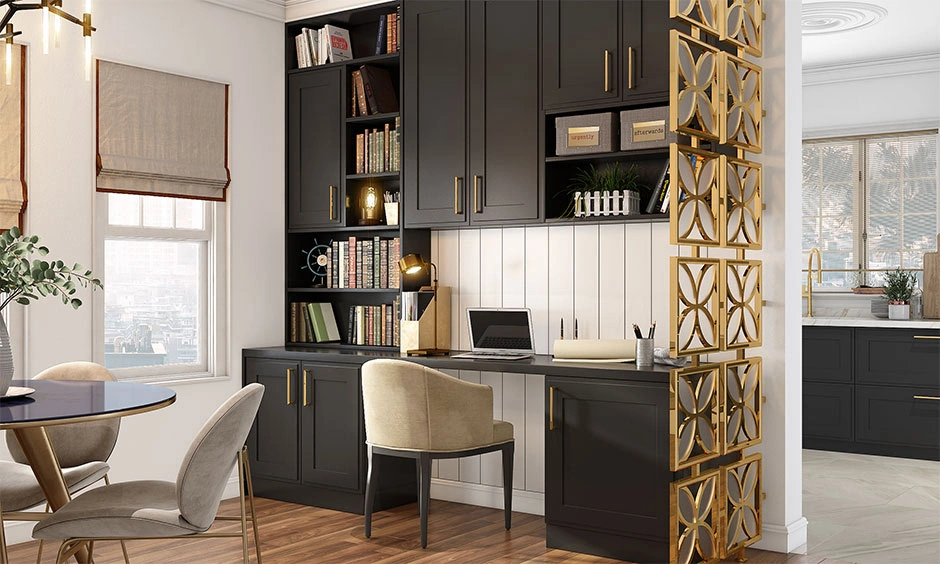
Modular designs use factory-made components assembled on-site, are more cost-predictable and are easier to relocate, while custom designs are built specifically for your home office, offering unique detailing and greater design flexibility.
Electrical and Technology Requirements
A functional work-from-home office setup in 2026 typically needs 4–6 power outlets near the desk plus dedicated points for routers, monitors, charging stations, etc. If the existing room has only one or two sockets, rewiring adds cost.
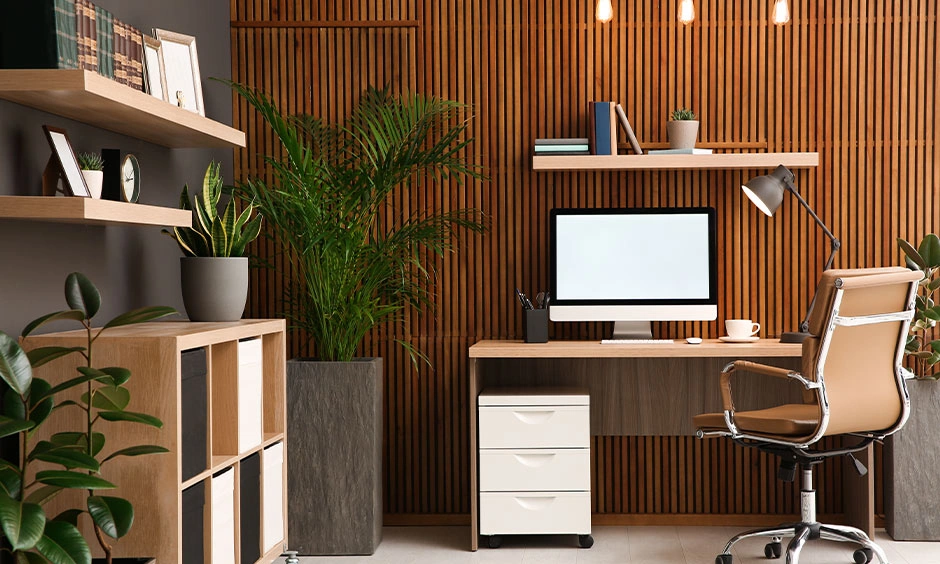
Latest Home Office Interior Ideas


Cost Breakdown Of A Home Office Design Project
A mid-range home office design project in India (approx. 80 to 100 sq ft) in 2026 breaks down roughly as follows:
| Cost Component | Estimated Cost (**) |
| Work desk and storage unit | Rs. 40000 – Rs. 80000 |
| Ergonomic chair | Rs. 12000 – Rs. 30000 |
| Lighting (task and ambient) | Rs. 15000 – Rs. 35000 |
| Electrical work and cable management | Rs. 10000 – Rs. 25000 |
| Wall treatment/paint/wallpaper | Rs. 8000 – Rs. 20000 |
| Accessories and decor | Rs. 5000 – Rs. 15000 |
| Design and execution fee | Rs. 15000 – Rs. 35000 |
| Total (Approx.) | Rs. 105000 – Rs. 240000 |
**These are indicative ranges. Actual costs vary by city, material brand and project complexity.
What is the ergonomic home office furniture cost?
The cost of ergonomic office furniture for a home office, say, a 6-footstudy table with storage is between Rs. 1.2 lakhs to Rs. 1.5 lakhs. The other prices based on the type of furniture you opt for are as follows:
- Basic mesh chairs – Rs. 8000
- Premium chairs – Up to Rs. 60000
- Quality ergonomic chairs – Rs. 18000 to Rs. 35000
- Motorised sit-stand desks – Rs. 30000 to Rs. 80000
Home Office Interior Cost Based On Room Size
| Room Size | Approximate Size | Cost Range |
| Compact corner nook | Under 40 sq ft to 150 sq ft+ | Rs. 50000 –Rs. 250000+ |
| Small dedicated workspace | ||
| Medium home office room | ||
| Large dedicated office room | ||
| Luxury home office |

Which Is More Cost-Effective: Modular Home Office or Custom Home Office?
Modular Home Office Interiors
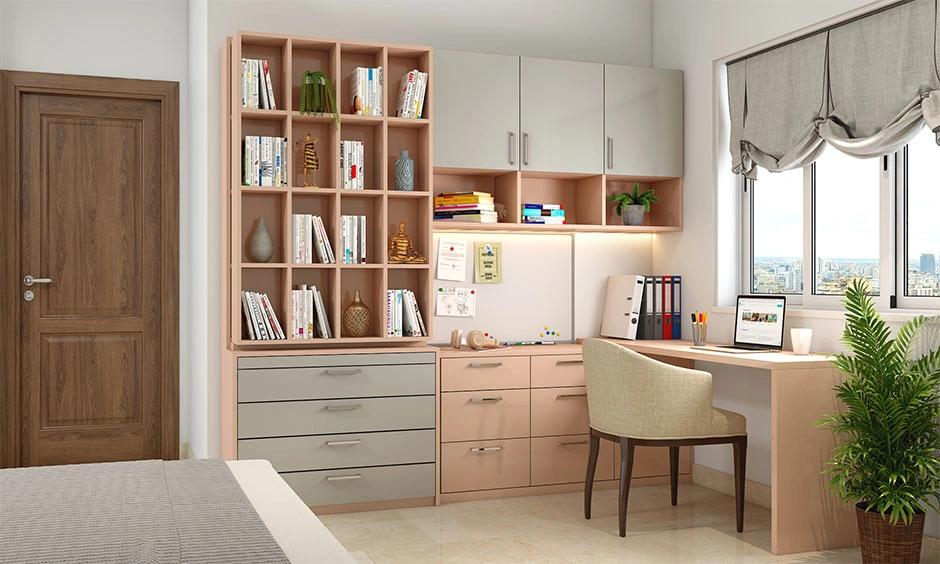
They use pre-engineered components that are manufactured in a factory with high precision and then assembled on the site, like wall-mounted desks, storage units and overhead cabinets. They have a faster lead time, have predictable costs and relatively easy reconfiguration. They typically cost 20% to 35% lower than custom home office interiors for equivalent functionality.
Custom Home Office Interiors
They are designed specifically for your space and built to the exact dimensions. They allow for unusual angles, integrated features (hidden cable routing and concealed storage) and bespoke material combinations that modular systems cannot always accommodate. They typically cost 30% to 50% more than the modular equivalents. They take longer to install, but they can extract maximum utility from constrained spaces.
The Verdict: For larger homes with a dedicated room and a high budget, custom home office interiors have higher ROI. For smaller apartments, modular home office interiors work better.
Budget-Friendly Home Office Design Ideas Or Small Home Office Design Ideas
- Standard laminate finishes over premium veneers reduce material costs by 30% to 40% with minimal visible difference in a well-created home office. Matted laminates are good for desks as they resist fingerprints and glare.
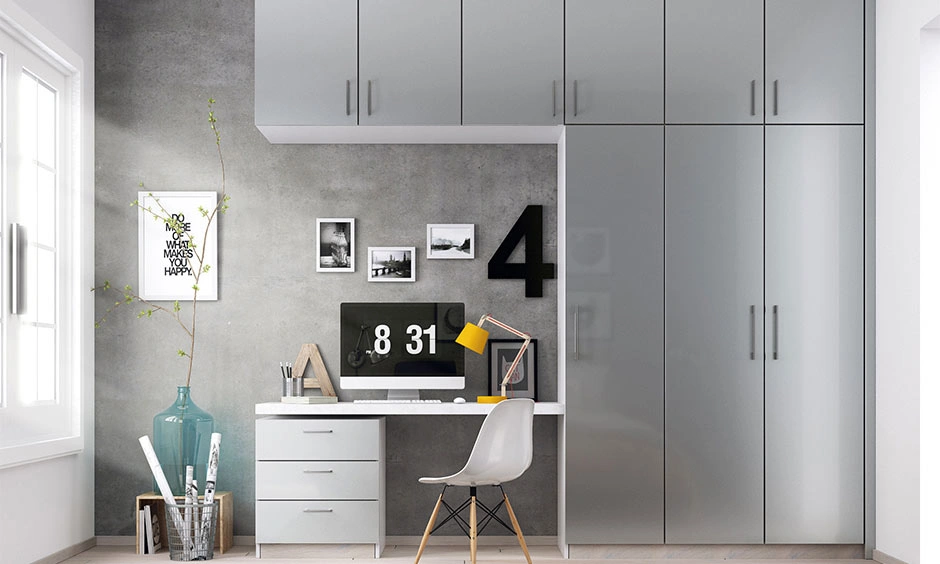
- Wall-mounted desks with a floating shelf are the most space-efficient and cost-efficient option for small apartments because they deliver a clean and functional workspace without consuming floor space.
- LED strip lighting under overhead cabinets is one of the most cost-effective upgrades in a home office because it provides direct task illumination that a ceiling light cannot replicate at a lower cost.
- Integrated wardrobe and study units are excellent for 2 BHK apartments where a dedicated room isn’t available. A wardrobe with a slide-out desk neatly tucks away when not in use, which maintains visual order.
- Multi-purpose furniture is well-suited to Indian urban apartments, and reduces total furniture spending. For instance, a desk that doubles as a study table or a storage ottoman that serves as additional seating.
What Are The Premium Features That Increase Home Office Renovation Costs?
- Quality ergonomic seating is the single highest-return investment in a home office. Coupled with lumbar support, adjustable armrests and seat depth adjustment, a good chair reduces fatigue significantly over long working hours.
- Acoustic panels and sound management matter more than people realise in apartments with hard concrete walls. Fabric acoustic panels reduce echo and ambient noise and improve user focus and audio quality of video calls.
- Height-adjustable work desks are popular among most Indian professionals. Motorised variants allow alternating between seated and standing positions, which is a well-established benefit for posture and energy levels.
- Smart lighting with CCT control (the ability to adjust between warm and cool white), such as smart bulbs or LED drivers, allows the home office to shift from a focused work environment during the day to a relaxed tone in the evening.
- Integrated cable management routed through desk channels or concealed wall conduits is the difference between a workspace that photographs well and one that actually functions cleanly day-to-day.
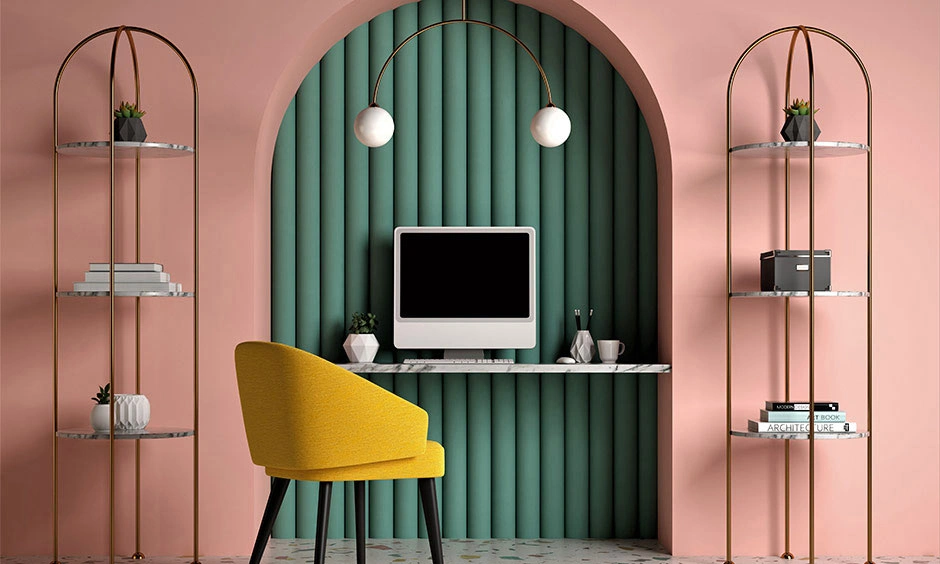
Common Mistakes That Can Increase the Work-From-Home Office Setup Costs
Buying the modular home office furniture before finalising the room layout
Buying modular home office furniture results in either poor ergonomics or expensive repositioning. For instance, a desk purchased from a retail store before the room layout is confirmed turns out to be the wrong size or positioned incorrectly relative to windows and electrical points.
Underestimating the electrical requirements in the planning stage
Not estimating the electrical requirements beforehand results in adding power points later on. This unexpectedly increases your home office setup cost. Chasing walls and reinstating finishes costs far more than routing cables during the original fit-out, so always plan for at least 2 more sockets than you currently need.
Choosing style over ergonomics when selecting home office interior designs
Ergonomics should define the dimensions, while aesthetics should work within them. Otherwise, it causes you to lose sight of the purpose of core functionality. For example, a visually striking desk with a shallow depth is uncomfortable for extended laptop use and unusable with an external monitor at the right distance.
Ignoring the natural light direction while setting up the home office space
Overlooking the direction of natural light can affect your productivity and efficiency during the actual work process. Positioning a monitor facing a window causes glare, whereas positioning it with a window directly behind causes contrast issues on video calls. Getting the desk orientation wrong is a daily irritant as well.
Separating the design from the execution during the transformation project
Buying furniture from one vendor, hiring a carpenter for the storage unit and sourcing lighting independently without a single design coordinator creates coordination gaps, inconsistent finishes and budgets that spiral past the original estimate. A single design-and-execution partner like DesignCafe avoids this fragmentation.

How To Plan Your Home Office Interior Cost?
A structured budgeting approach towards home office interiors prevents the two most common outcomes: over-spending on the wrong things and under-investing in things that matter. For a work-from-home setup, it is advisable to avoid excessive wall treatments and heavy design elements. Keep the walls minimal to make the room feel more spacious and calm, thereby creating a better working environment. This smart approach not only enhances the aesthetics of the space but also optimises the overall project cost. Here are the steps to follow:
- Step 1 – Define how you actually work. Start with behaviour, not aesthetics. Are you on video calls most of the day? You need good background treatment and lighting. Do you handle physical documents? You need more storage than average. Do you share the space with a partner? That changes the desk configuration entirely.
- Step 2 – Measure the space accurately and know your room’s dimensions before speaking to an interior designer. Understand where the natural light falls, where the existing power points are and whether there are any structural constraints (beams, columns, low ceilings).
- Step 3 – Separate the essentials from upgrades. Your core budget should cover the desk, ergonomic chair, adequate storage and proper task lighting. Everything else, from the acoustic panels and smart lighting, to the premium materials and the height-adjustable desk, is an upgrade that can be phased in.
- Step 4 – Use the 60/25/15 rule, that is, 60% on furniture and storage, 25% on lighting and electrical, 15% on finishes, decor and accessories. Many homeowners invert this ratio, spending heavily on visible finishes while underinvesting in the functional elements they use every hour.
- Step 5 – Build in a 10%-15% contingency buffer. Material costs, labour rates and scope changes during execution make contingency planning non-negotiable.
- Step 6 – Get a detailed quote from reputable design firms in your region, like DesignCafe, before committing. The company offers a free virtual consultation in which the team provides itemised cost estimates, allowing you to make informed trade-offs rather than discovering costs after the work has begun.
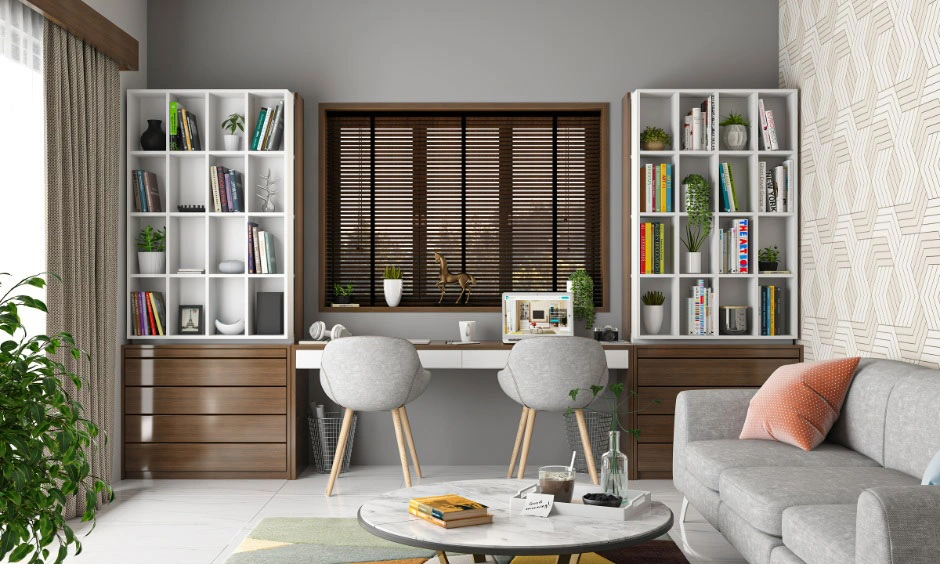
Wrapping Up
A well-thought out home office design is not only a luxury but an infrastructure for anyone who is working from home consistently. The most important insight from this guide is that the factors that most affect how a home office actually functions are also the factors that are most easily underbudgeted when modern homeowners plan without professional guidance, like lighting quality, ergonomics, electrical planning and storage logic. This is where the interior design team at DesignCafe can offer a free virtual consultation wherein you can discuss your requirements, explore home office design ideas and derive a tentative cost estimate for your project.
FAQs
1. How much does a home office interior design cost in India in 2026?
Home office interior design cost in India in 2026 ranges from Rs. 1.5 lakhs to Rs. 2.5 lakhs+, and this estimate is based on an office room size of 8 ft x 8 ft, which is designed to accommodate two workstations along with adequate wall storage and standard laminate finishes.
2. What factors affect the home office interior design costs?
The main factors that can affect the final home office interior design costs are room size, storage requirements, furniture quality (modular vs custom), material choices and finish grades, city of execution, lighting design and the degree of customisation.
3. What are the best home office design ideas for small apartments?
- Wall-mounted desks with floating shelves free up floor space.
- Corner office workstations use the otherwise unused angles.
- Foldable desk surfaces are useful for rooms that serve dual purposes.
- Wardrobe units with a study desk combo conceal the workspace when not in use.
4. What features should every home office include?
- An ergonomic desk at the correct height.
- Adequate task lighting at the desk surface.
- An ergonomic chair with proper lumbar support.
- Sufficient power outlets near the desk (minimum 4).
- Organised storage that keeps the desk surface clear.
- Simple cable management that prevents progressive disorder.
5. How can you design a productive home office setup on a budget?
- A wall-mounted desk with overhead shelves gives you a clean and functional workspace at low cost.
- Use LED strip lighting under overhead cabinets for task illumination rather than expensive pendant fittings.
- Invest in a decent ergonomic chair before spending on any other upgrade (discomfort is a big productivity cost).
- Choose matte laminate finishes over veneer (the practical difference in daily use is minimal, but the cost difference is vital).